The Best Hitch Bike Rack For Trucks: Why VelociRAX Is Built For Pickup Owners

Have you ever loaded your bikes into your truck bed only to find you don't have enough space left for your gear? Or filled the truck bed with gear only to realize you need just a little more space to fit your bike? As tailgate pads, tonneau covers and other truck accessories have grown in popularity, running out of truck bed space has become a frustratingly common tradeoff when carrying bikes. In this article we will compare the best truck bike rack options, including hitch bike racks for trucks, to ensure you can carry all your bikes without compromising on truck bed space, a lifted suspension, a tonneau cover, or full tailgate access.
What to Look for in a Truck Bike Rack
With options from truck bed racks, tailgate pads or even hitch mounted racks, Truck owners have a wide range of options for effective bike transport. Though each type of rack has their own tradeoffs the most important factors to consider when choosing a bike rack for your truck are its Size (how many bikes it can carry), its Strength (the durability of the rack), Speed (how quickly it can be used), Spacing (how much space in and around your vehicle is used), and Security (bike safety during transport). Here is a closer look at some of the most popular variations.

Tailgate Pad
Tailgate pads are quite popular among the mountain biking community. Essentially a large pad set over your truck's tailgate with straps to secure your bikes, many like them due to their affordable price and compact size. However, some of the downsides of a tailgate pad is that it does not hold bikes as securely as other rack options, using this rack takes up most of the available truck bed space and is generally not compatible with a tonneau cover.
Best For: Budget-conscious riders and occasional shuttling.
Bed Space: The pad occupies most of the available truck bed while in use.
Loading: Bikes must be lifted over the tailgate, no roll in loading.
Compatibility: Generally not compatible with a tonneau cover; a topper (camper shell) makes loading through the rear window difficult, and closing the window without hitting a bike gets tricky.
Watch Out For: Long-term paint rub where the downtube contacts the pad, dust and debris causing minor scratching, and a blocked backup camera.
Key Takeaway: The most affordable option on this list, but the tradeoffs in bed space and bike protection add up if you ride often or carry heavier bikes.

Truck Bed Rack
Truck Bed Bike racks are slightly more expensive than tailgate pads but hold bikes more securely as they must be placed in a fixed position. These bike racks are generally pretty small but a truck bed rack will take up the most truck bed space out of all of the listed options, even when not carrying bikes. Additionally, just like the tailgate pad, each bike will need to be fully lifted to the truck bed before it can be fully secured.
Best For: Riders who want fixed, secure bike positioning without hitch-rack cost.
Bed Space: Takes up bed space even when not carrying bikes. Uses the most bed space of any option here.
Loading: Bikes must be fully lifted into the bed before they can be secured.
Compatibility: Tonneau covers and toppers typically don't work well alongside a bed rack.
Watch Out For: Same e-bike lifting challenge as tailgate pads, plus limited bed space for gear even when the rack sits empty.
Key Takeaway: More secure than a tailgate pad, but its permanent bed footprint makes it a tough sell if you're running a tonneau or topper.

Hitch Racks
Hitch racks are the most expensive solution for bike transport but considering their high value and the need to safely secure one's bikes, the speed, strength and security of hitch mounted bike racks are unmatched. With a wide variety able to hold anywhere from 1 to 7 bikes, both horizontal and vertical hitch bike racks offer a great deal of customizability all while being compatible with truck accessories like toppers and tonneau covers. However, it is important to note that hitch mounted racks, especially platform style racks, will extend the length of your vehicle and must be accounted for when driving and parking.
Best For: Frequent riders, multi-bike households, and anyone running a tonneau cover or topper.
Bed Space: Fully retained as your truck bed stays completely clear.
Loading: Fast and straightforward; vertical racks in particular allow roll-in loading.
Compatibility: Works well with tonneau covers and toppers since the rack sits outside the bed entirely.
Watch Out For: Additional length behind the vehicle, especially with platform racks because the length grows with each additional bike, and can partially block backup cameras or parking sensors.
Key Takeaway: The most expensive category, but unmatched in speed, ease of use, security, truck bed space and accessory compatibility, especially with a vertical design.
Overall Summary
|
Feature |
Tailgate Pad |
Truck Bed Rack |
Standard Hitch Rack |
VelociRAX MAX |
|
Size (bed space retained) |
Low (Bed occupied) |
None (Bed occupied) |
100% Retained |
100% Retained |
|
Strength |
Low–Moderate |
Moderate |
Moderate–High |
High |
|
Stability |
Low (bikes can shift) |
Moderate |
Moderate |
High (built-in anti-rattle) |
|
Speed (load/unload) |
Slow (lifting required) |
Slow (lifting required) |
Fast |
Fastest (roll-in loading with adapter) |
|
Spacing (extra length added) |
None |
None |
Grows per bike (platform) |
Fixed, regardless of bike count |
|
Security |
Low |
Moderate |
Moderate–High |
High |
|
Tonneau/Topper Compatible |
No |
No |
Yes |
Yes |
|
Full Tailgate Access |
N/A |
Partial |
No |
Yes (with hitch adapter) |
|
Garage Storage |
N/A |
N/A |
Varies |
Yes (included garage mount) |
What about Car Customizations? Lifts, Toppers, Tailgates and Tonneau Covers
How do these racks hold up against the most popular truck accessories? Below is a quick breakdown by modification.
Lifted Suspension
All Rack Types: A lift makes every rack harder to use, since bikes must be lifted higher to reach the rack. Hitch racks are the least affected, since they already require the least lifting due to their tilting capabilities before the truck's height increase is factored in.
Key Takeaway: For 1–2 bikes, most rack types can be made to work with the right accessory combination. For toppers, tonneau covers, or 3+ bikes, a vertical hitch-mounted rack is the more reliable choice.
Toppers / Camper Shells
Tailgate Pad: Generally a poor match. You'll need to lift bikes through the rear window and it's hard to fully close the window without contacting a bike.
Truck Bed Rack: Slightly better than a tailgate pad, but maneuvering inside a topper is tight and securing bikes can still be difficult.
Hitch Rack: The best fit. Since the rack sits outside the bed, your topper and rear window stay fully accessible.
Tailgates
Tailgate Pad: Requires a standard tailgate shape. Aftermarket styles like flow-through or 5th-wheel tailgates may not be compatible.
Truck Bed Rack: Compatibility varies by rack type and bed spacing. Interference is usually minimal, but you may occasionally need to leave the tailgate open.
Hitch Rack: Some hitch-mounted racks restrict full tailgate lowering. Aftermarket accessories like the VelociRAX Hitch Adaptor add the clearance needed for full access.
Tonneau Covers
Tailgate Pad: Can work since some pads are specifically designed to fold and close alongside a tonneau cover but compatibility generally depends on your bed length and how much clearance the folded cover needs.
Truck Bed Rack: More complicated, since the rack and cover often compete for the same space. A few bed racks can mount on top of the cover or tuck against the bed base, but this should be evaluated case by case.
Hitch Rack: Fully compatible. The rack sits outside the bed entirely, so your tonneau stays usable no matter how many bikes you're carrying.

VelociRAX vs Traditional Hitch Bike Racks for Trucks
If you're just moving bikes from point A to B and aren't concerned about bed space, a tailgate pad may be all you need. But for frequent riders a vertical hitch rack tends to be the better fit. Its speed and strength save time, and many can double as garage storage when off the vehicle.
Built to Last: Steel Construction & Anti-Rattle System
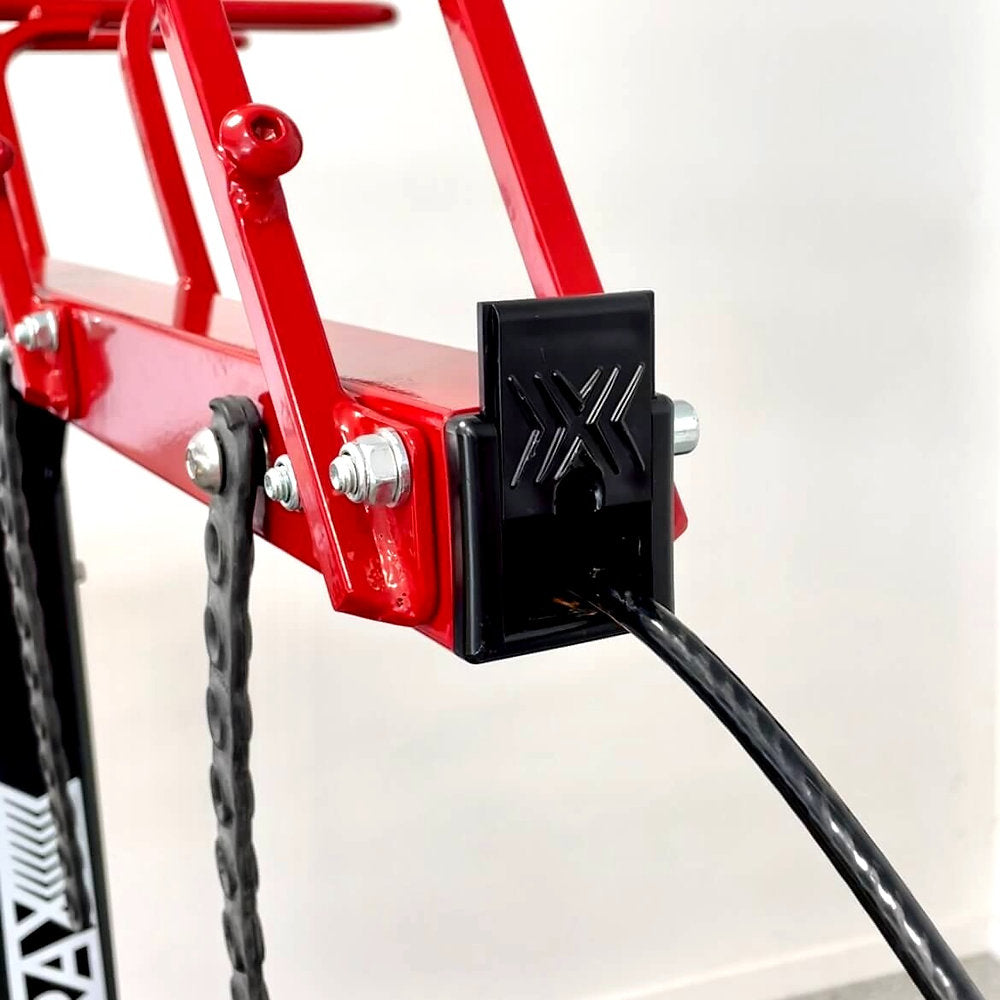
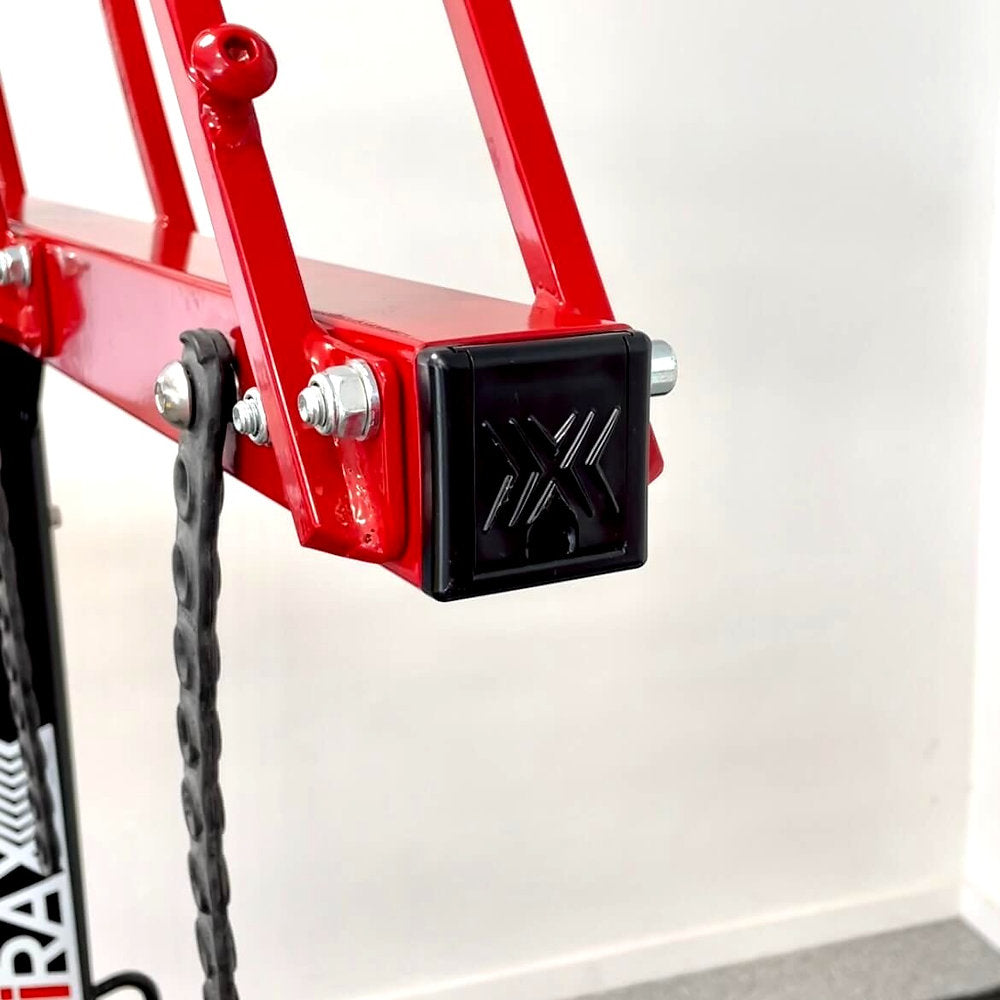
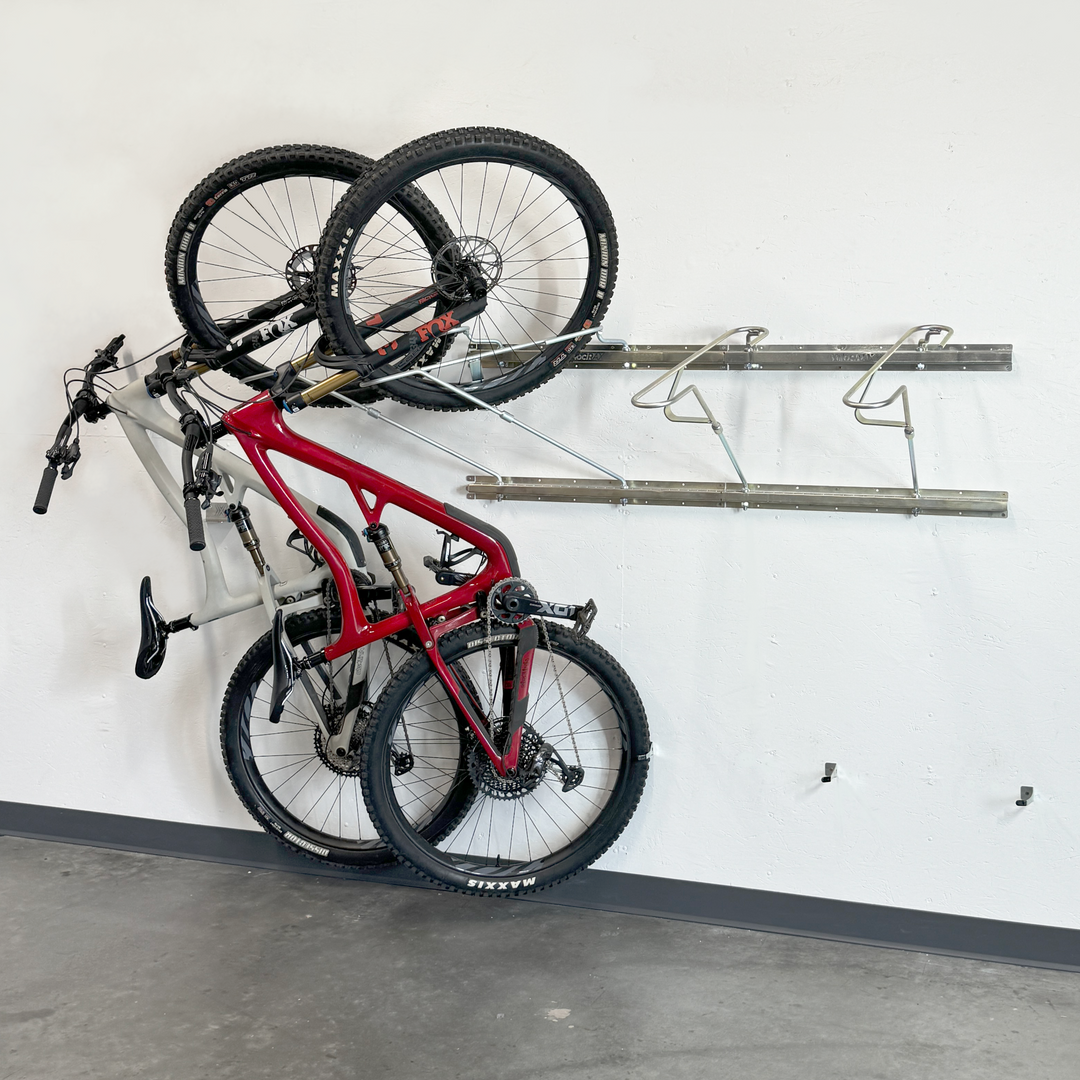
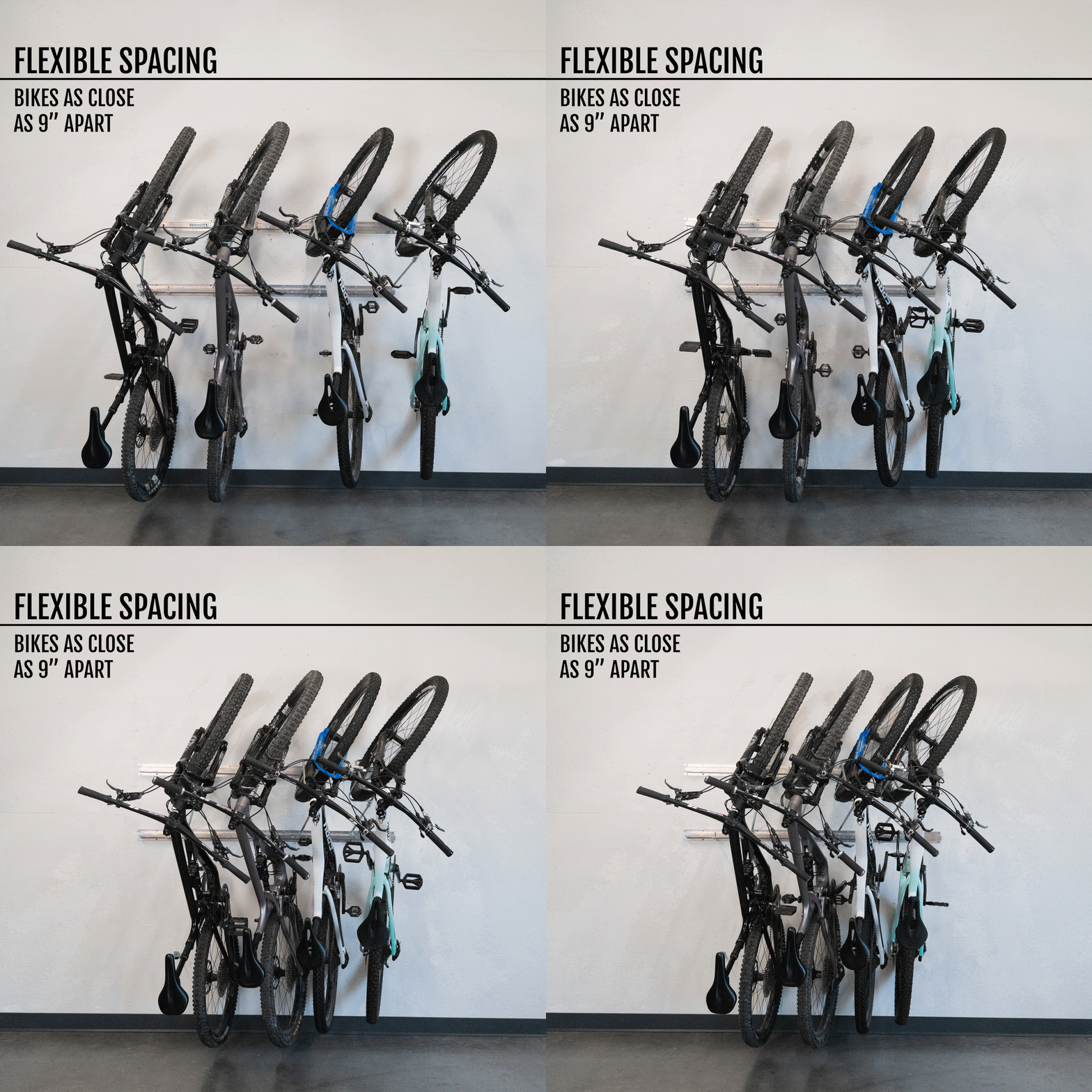
The VelociRAX Max is made with high-strength steel and a built-in anti-rattle system, designed to hold up under whatever your truck puts it through. Each rack also includes a garage mount, so your bikes stay organized even when the rack isn't on the vehicle.
Interested in examining the assembly process? Check out the Ultimate Setup Guide for the VelociRAX MAX Hitch Bike Rack and Garage Mount
The Vertical Advantage: Fixed Length, No Matter the Load
Like any hitch rack, the VelociRAX MAX adds length behind your vehicle, but because it's vertical rather than platform-style, that length stays fixed whether you're carrying one bike or seven. Platform racks, by comparison, grow with each additional bike. The vertical design also keeps bikes higher off the ground, reducing the risk of contact with potholes or speed bumps.
Solving the Tailgate Problem: The Hitch Adaptor
In the loading position, most truck tailgates will only lower 80–90% of the way before contacting the rack. The VelociRAX Hitch Adapter, built with the same anti-rattle technology as the rack itself, extends the rack out 4" and down 3½", giving enough clearance for the tailgate to fully lower. That extra drop also lowers the loading height, which can be the difference between rolling a bike in versus lifting it.

Sizing for Heavy-Duty Trucks
Heavy-duty trucks like the F-250, F-350, Silverado 2500, Ram 2500, and F-550 typically come with 2.5" or 3" hitch receivers rather than the standard 2". The hitch adapter is available in sizes to match these larger receivers. One important caveat: don't use a sleeve reducer to downsize a larger receiver to 2", this disables the rack's anti-rattle system and causes violent shaking during transport. The properly sized adapter avoids this entirely, riding as smoothly as a direct 2" insertion.
Want to take a quick look at this setup in action? Watch the video below.
Truck Fitment & Compatibility: What Works for Your Rig?
While vertical hitch racks are designed to fit any standard Class III 2-inch receiver, trucks present unique clearance and receiver challenges. Here is how the VelociRAX MAX performs across the most popular pickup setups:
1. Full-Size Light-Duty Trucks (F-150, Silverado/Sierra 1500, Ram 1500, Tundra)
-
Tailgate Clearance: In the default tilt/load position, most full-size tailgates will lower 80–90% before contacting the rack.
-
The Solution: Adding the VelociRAX Hitch Adapter extends the rack back 4" and drops it 3.5", allowing 100% full tailgate clearance.
-
Special Tailgates (GMC MultiPro / Ram Multifunction): GMC’s inner gate step fold-down can be lowered without dropping the main tailgate or needing to lower the rack, making bed access even faster.
Key Takeaway: Full-size half-ton trucks are the easiest setup but adding the Hitch Adapter gives you total bed access without removing bikes.
2. Heavy-Duty Workhorses (F-250/350, Silverado/Ram 2500/3500)
-
Receiver Difference: Heavy-duty trucks frequently come equipped with 2.5" or 3" Class 5 factory hitch receivers rather than the 2” receiver needed for the bike rack.
-
The Sleeve Reducer Trap: Do not use a sleeve reducer to downsize a 2.5" receiver to a 2" shank. Reducers disable the built-in anti-rattle mechanism of the hitch bike rack, causing violent rack wobble on the highway.
-
The Solution: Use the dedicated 2.5" or 3" VelociRAX Hitch Adapter. It fits snugly in your heavy-duty receiver while adapting down to a 2" interface with full anti-rattle functionality intact. To order please email a photo of your measured hitch receiver to support@velocirax.com and an invoice will be forwarded to you.
Key Takeaway: Match your adapter size directly to your hitch receiver. Do not rely on loose sleeve reducers.

3. Mid-Size Pickups & Factory OEM Hitch Quirks (Tacoma, Ranger, Gladiator)
Mid-size trucks handle vertical racks exceptionally well, but require extra attention to receiver geometry:
-
Hitch Depth Requirement: All VelociRAX setups require at least 3 ⅜” (86mm) of internal receiver depth past the center of the hitch pin hole.
-
Ford Ranger: Some factory OEM hitches lack this internal depth, preventing the shank from seating deep enough to align the pin hole.
-
Jeep Gladiator: Features an internal metal stop tab inside the factory hitch tube that can block full insertion.
Key Takeaway: Measure your receiver depth before ordering. If your factory hitch has an internal stop tab or shallow depth, an aftermarket Class III receiver solves the issue.
4. Truck Accessories: Toppers, Tonneau Covers & Lifts
-
Tonneau Covers (Hard or Soft Roll): 100% compatible. Because the rack sits outside the bed, you can flip, roll, or lock your tonneau cover anytime.
-
Camper Shells & Toppers: Unlike tailgate pads a vertical hitch rack keeps your bed hatch and glass window completely accessible.
-
Lifted Suspension / High Clearance: Lifted trucks make lifting 50+ lb e-bikes onto tailgate pads a back-breaking task. A vertical rack with a roll-in tire basket design drastically reduces lifting height.

FAQs
Does the VelociRAX MAX work with a 2" hitch receiver?
The rack itself is designed for a standard 2" receiver. If you're using the hitch adapter on a heavy-duty truck with a 2.5" or 3" receiver, the adapter comes sized to match. Do not use a sleeve reducer to downsize from a larger hitch as this disables the rack’s anti-rattle system.
What Bike Rack works best for pickup trucks?
Vertical hitch bike racks tend to be the best option for pickup trucks as when used with the VelociRAX hitch adaptor they allow full truck bed access, are compatible with popular truck accessories and minimize the horizontal footprint of your vehicle. Interested in seeing a vertical rack in greater depth? Check out our product page here.
Will my tailgate fully open with the rack installed?
With the rack alone, most truck tailgates will lower to about 80–90% of the way before contacting the rack. Adding the hitch adapter extends the rack out 4” and down 3.5” to allow enough space for full tailgate clearance.
How much extra length does the rack add behind my truck?
Because it's a vertical rack, the added horizontal length (50” with loaded bikes and 29” without) will always stay the same no matter how many bikes are added. With platform racks, which generally sit around 35" out from your vehicle an additional 10"-15" of space is needed for each additional bike.
Can I use a Sleeve Reducer with my bike rack?
No. Sleeve reducers disable the anti-rattle functionality of bike racks and cause rack and bike movement while traveling. As this can cause damage to your vehicle, rack and bikes, using a sleeve reducer with your bike rack is not recommended.
Does the rack block my backup camera or sensors?
Hitch mounted bike racks will partially obstruct backup cameras and cross-traffic sensors to various degrees depending on your truck's camera placement. If concerned it is worth checking with your specific vehicle prior to making a purchase.
What's the required hitch length for installation?
You'll need at least 3 ⅜" of clearance past the center of the hitch pin hole. Some newer factory OEM hitches, like the Ford Ranger, don't have this clearance by default. Others like the Jeep Gladiator may have a metal tab in the hitch that prevents full rack insertion.
Can I still use a tonneau cover or topper (camper shell) with a hitch rack installed?
Yes. This is one of the main advantages of a hitch-mounted bike rack over a tailgate pad or bed rack. Since the rack sits outside the truck bed, your tonneau or topper stays fully usable.
What is the best bike rack for a truck?
If you are planning to optimize your truck bed space and don’t want to add too much unnecessary length to your vehicle a Vertical Hitch Rack is the ideal choice for your truck. However if you don’t need the truck bed space a tailgate pad is a great and affordable option.

Built for Truck Use: Strength, Stability and Security
Trucks put unique demands on a bike rack. Between the added ride height, the extra torque from towing-capable frames, and the rough terrain many truck owners drive, a rack built for a sedan often doesn't hold up. The VelociRAX Max is built around those demands specifically: high-strength steel construction, a heavy duty anti-rattle system, and a vertical design that keeps bikes higher off the ground and clear of potholes or speed bumps.
This combination makes it best suited for:
-
Frequent riders and shuttlers who need to load and unload quickly without wrestling bikes onto a tailgate or into a bed.
-
Truck owners running a tonneau cover or topper who don't want to give up bed space or accessory function.
-
Heavy-duty truck owners (F-250/350, Silverado 2500/3500, Ram 2500/3500) who need the larger hitch adapter sizes to make the rack work with their class 5 receivers.
-
E-bike owners who want to avoid lifting heavy bikes onto a tailgate pad or bed rack.
It's a less obvious fit for occasional riders who only need to move one or two bikes a few times a year, as a tailgate pad's lower cost may outweigh the convenience gains. But for anyone who rides often, carries multiple bikes, and wants their truck bed to stay fully usable, VelociRAX Max is the rack built to do exactly that.
Interested in learning more? Check pricing and availability for the 5X Max rack on our product page.